Workers’ Compensation
After a work injury at a big Orchard Park venue, the hardest question usually is not what happened. It is who you actually work for.
The person who hired you, the company on your paycheck, the badge you wear, and the business that controls the site can be four different entities. Sorting that out is the first real job of an Orchard Park workers’ compensation lawyer, because it determines which insurance carrier pays, which company you can sue on top of the comp claim, and which one is untouchable.
Lewis & Lewis, P.C. has handled New York workers’ compensation for over 80 years, and we take these calls from the Southtowns constantly. Reach us at (716) 854-2100.
Who Is Your Employer at a Place Like Highmark Stadium?
Legally, it may not be the company whose name is on the building. New York looks at who directed and controlled the manner and details of your work, not at whose logo was on your shirt.
Orchard Park is now home to a $2.1 billion, 60,108-seat Highmark Stadium that the state announced as complete in June 2026, built on a 242-acre site. Its food service operator advertised 500 positions at a single hiring fair ahead of the 2026 season, covering cooks, dishwashers, cashiers, stand attendants, and supervisors.
An operation that size runs on layered employment. So do the town’s hotels, restaurants, and event contractors on game weekends.
If a staffing agency placed you
 You are likely covered, and the coverage may sit with either the agency or the business where you worked. The Workers’ Compensation Board’s guidance on leased employees explains that either the client employer carries a policy for the leased workers or the staffing company obtains one in the client’s name.
The complication is on the lawsuit side. New York’s Court of Appeals held in Thompson v. Grumman Aerospace Corp. that a temporary worker can be a “special employee” of the host business, and when that applies, comp is the exclusive remedy and the worker cannot sue the host in negligence.
Whether special employment exists turns on the facts. It is worth having someone read the placement arrangement before assuming either way.
If you worked for a contractor or concessionaire
Then the business running the site is often a third party, not your employer, and that distinction can be worth a great deal.
When Can You Sue Someone Besides Your Employer?
When a business other than your own employer caused the injury. Workers’ compensation is the exclusive remedy against your employer under WCL Section 11, and Section 29(6) extends that bar to coworkers in the same employ.
Almost everyone else is potentially reachable, subject to the special-employment exception above.
| Who caused it | What you have |
| Your own employer | Workers’ comp only |
| A coworker in the same employ | Workers’ comp only |
| Another contractor’s crew on the same site | Comp plus a negligence claim |
| The property owner or venue operator | Comp plus a negligence claim, if not your employer |
| A manufacturer of failed equipment | Comp plus a product claim |
Section 29 also lets you do both at once. The statute says an injured employee “need not elect” between compensation and pursuing a claim against someone else. If a third-party case recovers money, the comp carrier generally holds a lien on the proceeds, less the reasonable costs of recovery.
That lien is negotiable in practice, and how it gets handled changes what you actually keep.
Call (716) 854-2100 if a company other than your employer was involved. That is the fact pattern most worth a phone call.
Construction and Demolition Work in Orchard Park Right Now
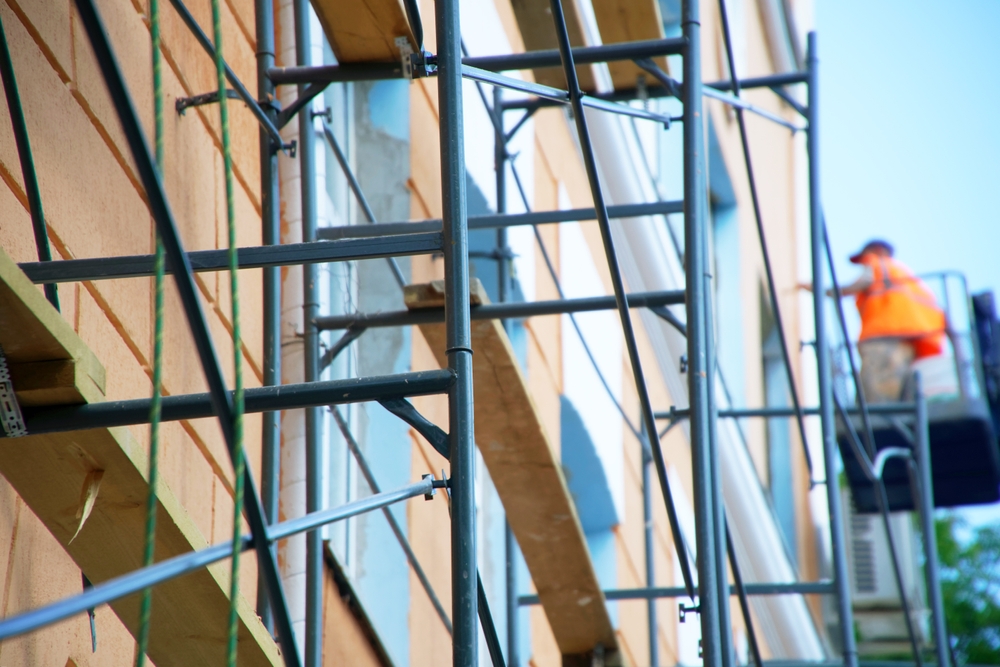 The old 1973 stadium played its final game in January 2026. Demolition began that May and is targeted to run through March 2027, which means Orchard Park currently has an active heavy demolition site and a brand-new venue operating across the road from each other.
New York gives construction workers protections that go beyond comp. Labor Law Section 240, the Scaffold Law, imposes duties on owners and contractors regarding scaffolds, hoists, ladders, and other safety devices in elevation-related work. Labor Law Section 241 requires construction, excavation, and demolition areas to be operated so as to provide reasonable and adequate protection and safety.
A fall from height on a demolition job is frequently both a comp claim and a Labor Law case against the owner or general contractor. Workers who only file the comp claim leave the pain and suffering side of it on the table, because comp pays no damages for pain and suffering at all.
Healthcare Injuries on the Southwestern Boulevard Medical Campus
Orchard Park has a 24-hour emergency department, not just an urgent care. Catholic Health operates the Mercy Ambulatory Care Center on Southwestern Boulevard, licensed as the Mercy Hospital Orchard Park Division, receiving ambulances around the clock.
Hospital work is one of the most injury-heavy occupations in the state. The Workers’ Compensation Board’s 2025 annual report records 161,264 claims assembled statewide that year, with health care and social assistance among the two largest industries by claim volume.
Patient transfers, combative patients, needle sticks, and back injuries from repositioning are the recurring claims. So are the shoulder and neck problems that build over years rather than arriving in one moment, which New York treats as occupational disease claims with their own filing rules.
The Orchard Park Central School District, which the town’s comprehensive plan lists alongside Erie Community College South among its largest employers, generates a parallel set of claims among aides, drivers, and custodial staff.
Can a Third Party Bring Your Employer Into the Case?
Only in narrow circumstances, and the threshold is high.
When an injured worker sues a third party, that third party sometimes tries to shift responsibility back onto the employer. WCL Section 11 permits that only where the worker suffered what the statute calls a grave injury.
The list is specific and short:
| Grave injuries under WCL Section 11 |
| Death |
| Permanent and total loss of use or amputation of an arm, leg, hand, or foot |
| Loss of multiple fingers or multiple toes |
| Paraplegia or quadriplegia |
| Total and permanent blindness, or total and permanent deafness |
| Loss of a nose, or loss of an ear |
| Permanent and severe facial disfigurement |
| Loss of an index finger |
| An acquired injury to the brain from external physical force causing permanent total disability |
Anything short of that list, and the employer stays out of the lawsuit. Knowing where a case falls shapes how the third-party claim gets built from the start.
What Does a New York Comp Claim Actually Pay?
Two-thirds of your average weekly wage, multiplied by your percentage of disability, and capped by a maximum that is set by the date of your injury.
| Date of accident | Maximum weekly | Minimum weekly |
| July 1, 2026 to June 30, 2027 | $1,281.50 | $384.45 |
| July 1, 2025 to June 30, 2026 | $1,222.42 | $325.00 |
| July 1, 2024 to June 30, 2025 | $1,171.46 | $275.00 |
Those figures come from the Board’s schedule of maximum weekly benefits. The rate is locked to your date of injury and does not rise later when new maximums are adopted, which surprises people with older claims.
Two more mechanics worth knowing. Lost wage benefits are not paid for the first seven days of disability unless the disability runs past fourteen days. And medical treatment for an established injury is covered without a copay, for as long as the injury requires it.
Your Erie County Hearing Will Probably Be Virtual
This trips up almost everyone. You will likely not be walking into a hearing room in Buffalo.
The Workers’ Compensation Board states that hearings are held on a virtual platform, and that represented claimants and lay witnesses scheduled to testify must appear by video with their faces fully visible. As of October 2024 the Board confirmed that virtual hearings remain the standard statewide, though you may ask the law judge during a hearing to have your next one in person.
What that means practically: your testimony happens from a room with a camera, a judge you have never met is watching your face, and the carrier’s attorney is in another window. It is a short proceeding with real consequences, and going into it unprepared is how people lose weeks of benefits.
We prepare clients for that specific format.
Why Orchard Park Workers Choose Lewis & Lewis
 Because the layered-employer problem is the whole case, and it takes someone who has untangled it before.
Michael T. Coutu has over 20 years as an injury lawyer and spent part of his career as a defense attorney, which is useful when the question is which of four companies a carrier will try to point at.
Emily F. Janicz, the firm’s president, has been named to the National Trial Lawyers Top 100 and came to Lewis & Lewis as a law clerk in 2010 while at the University at Buffalo School of Law.
There is a structural reason too. A comp claim can stay open for decades. Some clients here were hurt in the 1980s and are still represented, because the firm outlasted the partners who signed them up.
Published results on the comp side include $432,000 in schedule loss of use awards for a fast-food restaurant manager and $210,000 for a hospital technician who injured her neck and back. Prior results do not guarantee future outcomes.
Frequently Asked Questions
I work game days through a contractor. Which company’s insurance covers me?
Your direct employer’s carrier handles the comp claim, but “direct employer” is a legal conclusion, not what the schedule app says. Pay records, the hiring paperwork, and who supervised you all matter. Where a staffing arrangement exists, more than one policy may be in play.
The venue where I got hurt is not my employer. Can I sue it?
Possibly. That is exactly the third-party scenario Section 29 permits alongside a comp claim. The exception is if you are found to be a special employee of that business, in which case the negligence claim is barred.
I got hurt on the demolition site. Is that different from a normal work injury?
Often, yes. Demolition and construction work brings Labor Law 240 and 241 into play against owners and general contractors, on top of the comp claim. Those cases can include damages comp does not pay.
I was hurt during an event, hours after my scheduled shift ended. Is that covered?
Quite possibly. Event work rarely ends when the schedule says it does, and whether an injury arose out of and in the course of employment turns on what you were actually doing and at whose direction. Being off the clock on paper is not the end of the analysis.
My employer says I have to use their doctor. Is that true?
Only in a limited way. If your employer uses a preferred provider organization you may have to start in network, but the Board’s health care rules allow you to move to any Board-authorized provider 30 days after your initial treatment. In a medical emergency, an insurer cannot require you to use a network provider for a diagnostic test.
Start With One Phone Call and a Paystub

You do not have to figure out the corporate chart before you call. That is our work, and it is the part that decides how much your claim is worth.
Lewis & Lewis, P.C. is at 430 Dick Rd., Depew, NY 14043, minutes from the US 219 and Route 20 corridors that Orchard Park runs on. Call (716) 854-2100 for a free consultation, or read about Hamburg workers’ compensation, neighboring West Seneca workers’ comp, and the Buffalo metro workers’ comp process.
Get Help Today
Fill out the form below, and one of our personal injury attorneys will contact you within 24 hours.
"*" indicates required fields
Satisfied Client Stories
”I liked Lewis & Lewis from the beginning when they helped me sort through all the paperwork-related to my injury. They really helped me get organized. But what really impressed me was when my Lewis & Lewis personal injury lawyer obtained thousands of dollars in workers’ compensation benefits that I didn’t even know I was entitled to. My attorney worked hard to get me paid.
Fred T.Kenmore, NY - Steam Fitter
SEE TESTIMONIALS