Workers’ Compensation
A lot of West Seneca works for an institution. A school district, a state care facility, a town department. That changes the calculation after an injury in a way nobody talks about.
If you are going to see the same supervisors next month and the month after, filing a claim stops feeling like paperwork and starts feeling like a decision about your standing at work.
A West Seneca workers’ compensation lawyer hears that hesitation more often than any other. The honest answer has two halves: the law protects you from being punished for filing, and it does not protect your job in the way most people assume.
Lewis & Lewis, P.C. has represented injured workers across Western New York for over 80 years. Call (716) 854-2100 and ask what you are actually risking.
What Happens to a Public Employee’s Job During a Comp Claim?
 The job is not automatically protected, but you cannot be punished for filing. Those are two different things, and institutional employers are where the difference bites hardest.
Workers’ Compensation Law Section 120 makes it unlawful for an employer to discharge or in any other manner discriminate against an employee because that employee has claimed or attempted to claim compensation. It also protects requesting the forms and testifying in a case.
A violation carries a penalty payable by the employer, and the Board can order you restored to your former position with back compensation and attorney or representative fees. Complaints go to the Board’s Disability and Discrimination Unit on Form DC-120, and the statute sets a two-year window from when the discrimination happened. The Board’s discrimination page walks through the process.
The job-protection gap
The comp law does not require anyone to hold your position open. The Board puts it this way: “the Workers’ Compensation Law does not require your employer to hold your job for you if you are not able to work because of an injury, and your employer needs to fill your position for business reasons” (Board guidance).
Note both conditions in that sentence. It applies where you are unable to work and where the employer has a business reason to fill the role.
For public and institutional employees, the practical answer usually lives in a contract rather than in the statute. Collective bargaining agreements in school districts, state facilities, and municipal departments frequently hold a position for a negotiated period, and civil service rules may add their own protections.
Separately, the federal Family and Medical Leave Act may provide job restoration for eligible employees, and the Americans with Disabilities Act may require a reasonable accommodation in some situations.
Injuries Inside State Care Facilities
West Seneca has a large state institutional workforce, and it produces a distinct injury profile.
The New York State Office for People With Developmental Disabilities operates the Western New York Developmental Disabilities Services Office at 1200 East and West Road. A state feasibility study of that campus recorded 395 OPWDD employees working there across roughly 309,000 square feet, on a site where 31 of 38 studied buildings sit vacant. The state also runs a children’s psychiatric center in the town.
Direct care is physical work. Lifting and transferring residents, absorbing a fall, restraining someone in crisis, and repetitive bending over a bed for years produce shoulder, back, and knee claims that carriers routinely challenge as degenerative rather than work-related.
The West Seneca Central School District reports close to 1,170 full-time equivalent staff across nine schools, which makes it among the town’s largest employers. Aides who assist students with mobility face the same lifting exposure.
Is an Assault at Work Covered in New York?

Usually yes, and there is a legal presumption working in your favor.
WCL Section 21 supplies a statutory presumption in the injured worker’s favor. New York’s Court of Appeals applied it in Matter of Rosen v. First Manhattan Bank, holding that an assault arising in the course of employment is presumed to have arisen out of the employment unless there is substantial evidence it was motivated by purely personal animosity.
For someone injured by a resident, a patient, a student, or a member of the public, that presumption matters. You do not have to prove the assailant intended a work-related result. The carrier has to produce real evidence that the attack was personal and had nothing to do with the job.
Psychological injury from a violent incident is treated as its own category of claim, and documenting it early matters more than most people realize.
Call (716) 854-2100 if you were hurt in an incident at work. These claims get contested more than they should.
The Plow, the Compost Pile, and 220 Miles of Road
Municipal work in a lake-effect town is one of the more injury-prone jobs in Erie County, and it is almost never written about.
The Town of West Seneca Highway Department reports 60 full-time and 15 seasonal employees maintaining 220 miles of roadway, plus a compost facility that can handle up to 40 tons of yard waste on a spring day. That is plow operation on overnight shifts, sanitation lifting, chainsaw and chipper work, and equipment maintenance in the cold.
The town is also where US 219 ends at the Thruway, which means truck traffic, loading docks, and distribution work along the Route 20 corridor.
Injuries from that kind of work tend to be either sudden and obvious, like a fall from a truck, or slow and deniable, like a shoulder that stopped working after fifteen winters. The second kind needs a different filing strategy.
Injuries That Build Up Instead of Happening at Once
New York recognizes occupational disease claims, and they are not limited to the famous ones.
Most people know carpal tunnel qualifies. Fewer realize the category is not limited by body part at all. Fewer still know about hearing loss, which is one of the most under-filed claims in the state.
A hearing loss claim is brought after you are no longer working in the noisy environment, typically after retirement or a job change. It can provide a lump sum for permanent hearing loss plus coverage for hearing aids, which are rarely covered well by other insurance and are expensive to replace.
The filing clock is different for these claims. Under WCL Section 28, the two-year period for an occupational disease generally runs from disablement and from when you knew or should have known the condition came from your employment, rather than from a single accident date.
Do You Have to Look for Work While You Are Out?
Sometimes, and the rule is more nuanced than either side usually explains.
A worker with a temporary partial disability who is not working generally has to demonstrate what the Board calls attachment to the labor market in order to keep receiving lost-wage benefits. The Board’s guidance accepts an independent job search that is timely, diligent, and persistent, along with vocational rehabilitation, job retraining, full-time educational enrollment, or active participation with a New York State One-Stop Career Center.
Documentation is exacting. For each contact the Board wants the date, the employer’s name and address, the person you spoke with and their number, the job sought, and the response.
There is an important exception. Workers who are classified with a permanent partial disability and were attached at the time of classification no longer have to keep demonstrating attachment. Carriers do not always volunteer that distinction, and workers lose benefits over it.
What Gets Decided When You Reach Maximum Medical Improvement
Two different things, depending on which body part is involved.
For arms, hands, fingers, legs, feet, toes, eyes, hearing, and disfigurement, the Board makes a schedule loss of use award. WCL Section 15(3) sets the maximum weeks by body part, such as 312 weeks for an arm, 288 for a leg, 244 for a hand, and 160 for an eye.
Temporary benefits you already received are typically credited against that award, which is why the number people expect and the check they get do not match.
The back and neck are not schedule body parts. Those go the classification route, where benefits are capped by your loss of wage earning capacity.
| Loss of wage earning capacity | Maximum weeks of benefits |
| More than 95% | 525 |
| More than 90% to 95% | 500 |
| More than 85% to 90% | 475 |
| More than 80% to 85% | 450 |
| More than 75% to 80% | 425 |
| More than 70% to 75% | 400 |
| More than 60% to 70% | 375 |
| More than 50% to 60% | 350 |
| More than 40% to 50% | 300 |
| More than 30% to 40% | 275 |
| More than 15% to 30% | 250 |
| 15% or less | 225 |
Permanent total disability is different again. Section 15(1) provides benefits for as long as the total disability continues.
This is the stage where a claim is won or lost quietly, because the percentage assigned to you now sets the ceiling on everything that follows.
Why West Seneca Workers Hire Lewis & Lewis
 Because these claims outlast careers, and continuity is not a marketing point here.
The firm has clients who were injured in the 1980s and are still represented, handed from one generation of partners to the next.
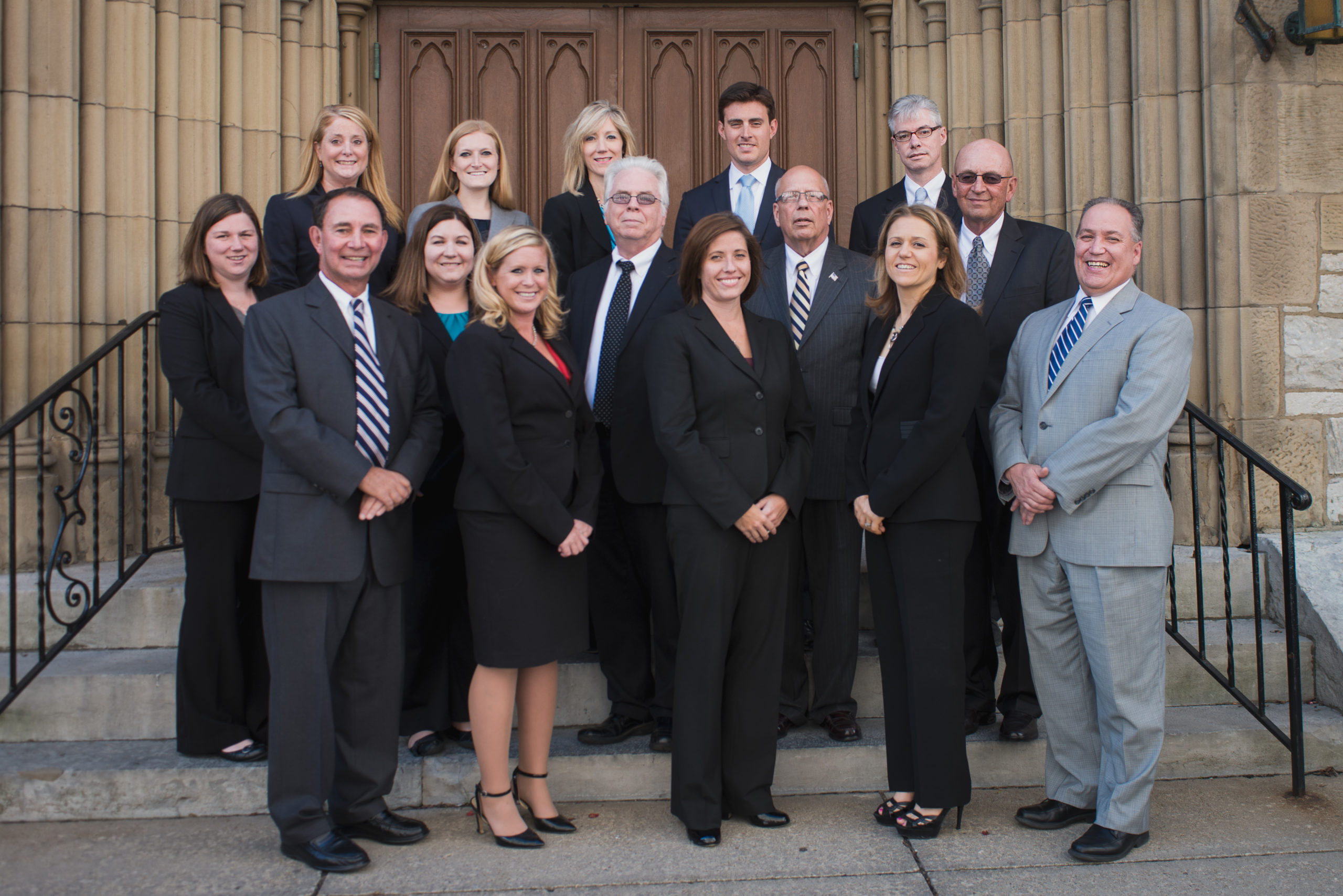
Emily F. Janicz, now the firm’s president, joined as a law clerk in 2010 while at the University at Buffalo School of Law and has been named to the National Trial Lawyers Top 100. Michael T. Coutu has over 20 years as an injury lawyer and previously worked as a defense attorney.
There is also the plain fact of proximity. Our Depew office is roughly a ten-minute drive from most of West Seneca, which matters more than it sounds when a claim runs for years and paperwork keeps arriving.
Published results include a finding of permanent total disability with lifetime lost wage benefits for a delivery driver, and $180,000 for a workplace fall on ice that tore a hip labrum and required surgery. Prior results do not guarantee future outcomes.
Frequently Asked Questions
I work for the state. Does the process work differently for me?
The benefits and the statutes are the same, but the administration differs, and public employers often handle claims through their own arrangements rather than a commercial carrier. Union representation may also give you contractual rights that run alongside the comp claim.
A resident I care for injured me. Will that be treated as my fault?
It should not be. The Section 21 presumption puts the burden on the carrier to show the incident was purely personal. Where the person you were caring for has a documented history of behavior of that kind, the claim is usually stronger, not weaker.
My hearing has been bad for years and I retired last spring. Is it too late?
Possibly not. Hearing loss claims are typically filed after you leave the noisy work, and the occupational disease clock runs from disablement and knowledge rather than from a date years ago. It is worth asking.
My doctor says I have reached maximum medical improvement. Should I be worried?
It is a turning point, not bad news by itself. It moves the case from treatment into permanency, where a percentage gets assigned and a number attaches to it. That is the moment to have someone reviewing the medical report before it becomes the basis of an award.
My supervisor has been cold with me since I filed. Is that discrimination?
It might be. Section 120 covers discharge and also discrimination “in any other manner,” which can include changed assignments, hours, or treatment. Write down what changed and when, with dates, and bring it in.
The Question Is Not Whether to File. It Is How.
Almost everyone who calls us has already decided they were hurt at work. What they need is someone to tell them what filing actually sets in motion, and what it does not.
Lewis & Lewis, P.C. is at 430 Dick Rd., Depew, NY 14043. Call (716) 854-2100 for a free consultation, or read about neighboring Hamburg workers’ comp, Orchard Park workers’ compensation, and the Buffalo metro workers’ comp process.
Get Help Today
Fill out the form below, and one of our personal injury attorneys will contact you within 24 hours.
"*" indicates required fields
Satisfied Client Stories
”I liked Lewis & Lewis from the beginning when they helped me sort through all the paperwork-related to my injury. They really helped me get organized. But what really impressed me was when my Lewis & Lewis personal injury lawyer obtained thousands of dollars in workers’ compensation benefits that I didn’t even know I was entitled to. My attorney worked hard to get me paid.
Fred T.Kenmore, NY - Steam Fitter
SEE TESTIMONIALS